ATTILA KONNYU 孔瑜
ART & PHILOSOPHY
UNIVERSAL VISUAL LANGUAGE (2026)
Selected Works, Films and Essays
English and Chinese bilingual edition
DIGITAL REVIEW COPIES
Selected publications on Attila Konnyu’s artistic practice and philosophy are available as digital review copies upon request.
.png)
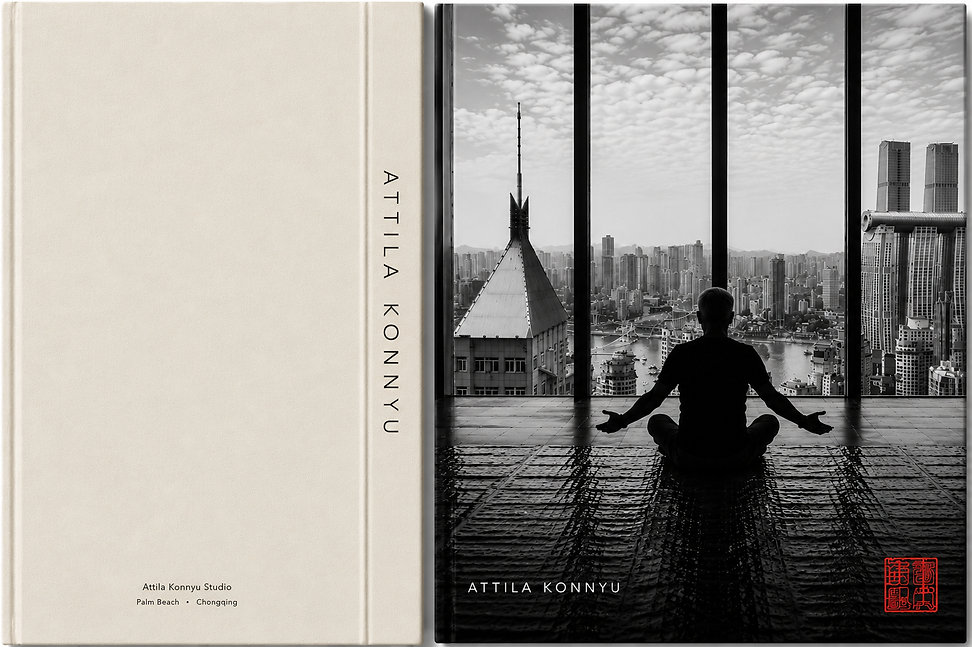
Universal Visual Language explores painting not as representation but as a field of perception. Drawing on decades of artistic practice across Europe, the United States and China, Attila Konnyu proposes a visual language rooted in archetypal structures, Taoist philosophy and the shared cognitive foundations of human experience.
Rather than functioning as a conventional exhibition catalogue, the publication establishes the conceptual foundation of Konnyu's painting practice, examining the relationship between perception, gesture, time and consciousness. It presents painting not as a static image, but as an evolving mode of inquiry into the deeper structures of visual experience.
ISBN 978-615-83113-0-4
ISBN (EPUB) 978-615-83113-1-1
THE MANIFESTATION TRILOGY
Three Volumes on the Origin, Perception, and Responsibility of Art
I. The Philosophy of Manifestation
II. The Theory of Universal Visual Language
III. Manifestation
The Manifestation Trilogy brings together three interconnected volumes developed from more than four decades of artistic practice across Europe, the United States, and China.
Rather than proposing a closed aesthetic doctrine, the trilogy examines art as a living process: from the emergence of the work, through its capacity to create a shared field of perception, to the ethical and cultural responsibilities that arise when it enters the world.
Together, the three books form a continuous philosophical inquiry into the origin, communication, and presence of art.

I
THE PHILOSOPHY OF MANIFESTATION
Art as the Invisible Made Perceptible
How does a work of art come into being?
The Philosophy of Manifestation examines how a work of art comes into being. Drawing on Attila Konnyu’s meditation-based practice, the book considers the relationship between inner attention, gesture, energy, material resistance, and the emergence of form.
The work of art is approached not as the execution of a predetermined image, but as an event in which perception, material, and artistic presence gradually converge.
ISBN 978-615-83113-6-6
ISBN (EPUB) 978-615-83113-7-3

II
THE THEORY OF UNIVERSAL VISUAL LANGUAGE
Art as a Shared Field of Perception
How can a work of art create connection?
The Theory of Universal Visual Language investigates how art can create connection across individual and cultural differences. It examines the shared foundations of visual perception, archetypal form, material presence, time, and the active role of the viewer.
The universal is presented not as a fixed code or uniform style, but as the possibility of a shared perceptual field in which different histories and experiences can genuinely meet.
ISBN 978-615-83113-8-0
ISBN (EPUB) 978-615-83113-9-7

III
MANIFESTATION
When the Work Enters the Shared World
What happens when a work of art enters the world?
Manifestation follows the work of art beyond the moment of its creation and into the shared world of viewers, cultures, institutions, and public attention. The book considers the ethics of the image, the viewer’s time, cultural mediation, technology, artificial intelligence, and the changing responsibilities of the artist.
Artistic responsibility is understood not as a limitation of freedom, but as the care, precision, and openness through which a work can become a meaningful presence in the world.
ISBN 978-615-83171-0-8
ISBN (EPUB) 978-615-83171-1-5
Emergence. Connection. Responsibility.
The three volumes are not repetitions of a single idea, but successive stages of one artistic philosophy: the work comes into being, creates a field of connection, and assumes a presence within the shared world.